


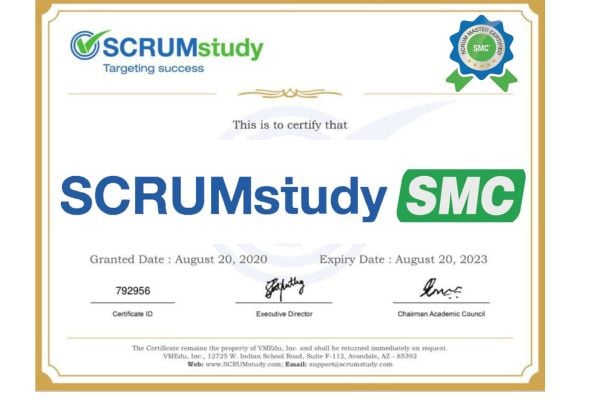
1. Name
- Scrum Master Certified (SMC®)
2. What you will learn
- Practical, working knowledge of the Scrum framework.
- How to implement and tailor Scrum in various project scenarios.
- The role of a Scrum Master as a facilitator (guiding the team, clearing impediments, and ensuring process adherence).
- In-depth understanding of Scrum roles, meetings, and artifacts.
3. Audience Profile
- Individuals interested in working as a Scrum Master.
- Existing Scrum Masters looking to formalize their skills.
- Professionals from any industry (not just IT) as Scrum is applicable across diverse sectors.
- Note: Technology expertise is not required to be an effective Scrum Master.
4. Prerequisites
- Formal Prerequisites: None.
- Recommendations: It is preferable to complete the Scrum Developer Certified (SDC®) certification first and attend a 2-day SMC classroom training.
5. Exam Format
- Type: Multiple choice.
- Questions: 100 questions.
- Duration: 120 minutes.
- Delivery: Proctored online exam.
- Marking: No negative marks for wrong answers.
- Success Rate: Current pass rate is 95%.
6. Course Outcomes
- Ability to define and work with Scrum concepts, advantages, and challenges.
- Readiness to adopt the Scrum Master role and help organizations transition to Agile.
- Experience gained through practical role-plays and case-study simulations.
- Tools to address and resolve Scrum-related issues within an organization.
7. Course Methodology
- Engaging and Interactive: Focuses on high retention through internalization rather than just listening.
- Hands-on Training: Uses role-plays and case studies to simulate real-world product development.
- Comprehensive Resources: Includes high-quality videos, study guides, and chapter tests.
8. Course Outline
1. Agile and Scrum Overview: Manifesto, principles, methods, and advantages.
2. Scrum Roles: Core roles (Product Owner, Scrum Master, Scrum Team) and non-core roles.
3. Scrum Project Phases: Initiate, Plan and Estimate, Implement, Review and Retrospect, and Release (including Inputs, Tools, and Outputs).
4. Scaling Scrum: Scalability, Programs/Portfolios, Scrum of Scrums (SoS), and transition strategies.
9. About Institution
- SCRUMstudy™ is the global accreditation body for Scrum and Agile certifications. They authored the SBOK® Guide (Scrum Body of Knowledge) and manage a global network of Authorized Training Providers (A.T.P.s). They offer a complete certification hierarchy ranging from fundamentals to expert-level masters.