


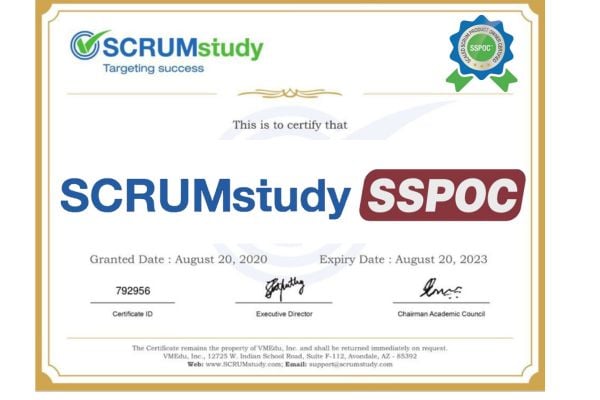
- Scaled Scrum Product Owner Certified (SSPOC™)
2. What You Will Learn
- Principles and practical working knowledge of the Scrum framework.
- Deep understanding of Scrum roles, meetings, and artifacts.
- How to implement Scrum effectively within various organizations.
- Preparation for the SSPOC™ certification exam.
3. Audience Profile
- This course is designed for professionals aiming for leadership roles in scaled environments, including:
o Chief Product Owners, Program Product Owners, and Portfolio Product Owners.
o Scrum Core Team Members (Product Owners, Managers, Project Managers).
o Technical staff (Programmers, Designers, Testers, Software Engineers).
o Business leadership (Executives, Business Owners, Analysts, Sponsors).
4. Prerequisites
- Formal: None.
- Preferred: Completion of the Scrum Product Owner Certified (SPOC®) certification.
- Recommended: Attending training through a SCRUMstudy approved Authorized Training Partner (A.T.P.).
5. Exam Format
- Type: Multiple choice.
- Questions: 70 questions.
- Duration: 90 minutes.
- Format: Proctored online exam.
- Scoring: No negative marks for wrong answers.
- Pass Rate: Current rate is 95%.
6. Course Outcomes
- Ability to define and apply Scrum Framework advantages and challenges.
- Readiness to act as a Chief, Program, or Portfolio Product Owner.
- Hands-on experience through role-plays and project simulations.
- Skills to address and resolve practical Scrum implementation issues.
- Formal certification upon successful completion of the exam.
7. Course Methodology
- High Engagement: Focus on retention through active participation rather than passive listening.
- Practical Application: Uses role-plays to simulate the Scrum flow.
- Case Studies: Real-world simulations to practice product development within the Scrum Framework.
8. Course Outline
1. Agile Overview: Manifesto, principles, and comparison to traditional management.
2. Scrum Overview: Planning, framework, roles, and flow.
3. Initiate: Vision creation, identifying stakeholders, and backlog prioritization.
4. Plan and Estimate: User stories, estimation, and sprint backlog updates.
5. Implement: Deliverables, daily standups, and backlog refinement.
6. Review and Retrospect: Sprint validation and retrospectives.
7. Release: Shipping deliverables and release retrospectives.
8. Scaling Scrum for Large Projects: Impact on fundamental processes and additional I/O.
9. Scaling Scrum for the Enterprise: Managing programs, portfolios, and the Scrum Guidance Body.
9. About Institution
- SCRUMstudy™ is the global accreditation body for Scrum and Agile certifications. They are the authors of the SBOK® Guide (A Guide to the Scrum Body of Knowledge) and operate through a massive global network of Authorized Training Providers (A.T.P.s) to deliver standardized, high-quality professional certifications.
-