


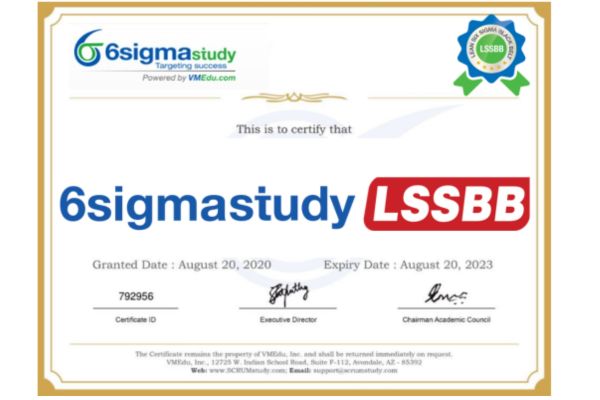
Lean Six Sigma Black Belt (LSSBB) Certification (Course and Exam)
Comprehensive integration of Lean and Six Sigma methodologies.
Advanced quantitative and qualitative tools for process improvement.
The DMAIC framework (Define, Measure, Analyze, Improve, Control).
Leadership skills to manage critical projects and project teams.
Techniques to reduce waste, minimize defects, and optimize production.
Team leaders, supervisors, and quality assurance engineers.
Project managers and software professionals.
Working executives and senior management.
Functional managers seeking significant business results.
Individuals aiming to lead full-time improvement projects or research/consulting in process improvement.
Not explicitly stated in the source text; however, the profile targets professionals ready to lead full-time improvement projects and master advanced statistical/analytical tools.
Delivery Method: Online.
Validity: 6 months.
(Specific question count and duration are not detailed in the provided snippet).
Alignment of Six Sigma/Lean concepts with business missions.
Ability to transition projects through all phases of DMAIC.
Development of superior problem-solving skills for real-world application.
Mastery of Lean tools (5S, Waste Reduction, Value Stream Mapping, Poka-yoke).
Capability to define, present, and manage complex improvement projects.
Focus: Practical implementation of tools and techniques within an organization.
Structure: Online delivery combining theoretical knowledge with practical case studies.
Approach: Utilizing both quantitative and qualitative methods to address business issues.
Introduction: History of Quality, Gurus, Leadership, and Team Dynamics.
Define Phase: Stakeholders, VOC, Kano Model, QFD, and Project Charters.
Measure Phase: SIPOC, Process Mapping, Data Collection, Gauge R&R, and Statistics.
Analyze Phase: Regression Analysis, Hypothesis Testing, FMEA, and Root Cause Analysis.
Improve Phase: DOE, Poka-yoke, 5S, Kanban, SMED, and Kaizen.
Control Phase: Statistical Process Control (SPC) and Sustaining Improvements.
Special Topics: DFSS (Design for Six Sigma) and Advanced Lean/Logistics.
Practical Application: Multiple comprehensive Case Studies.
The specific name of the institution is not mentioned in the source; the focus is on a standardized approach to problem-solving for global organizations